

Product Description
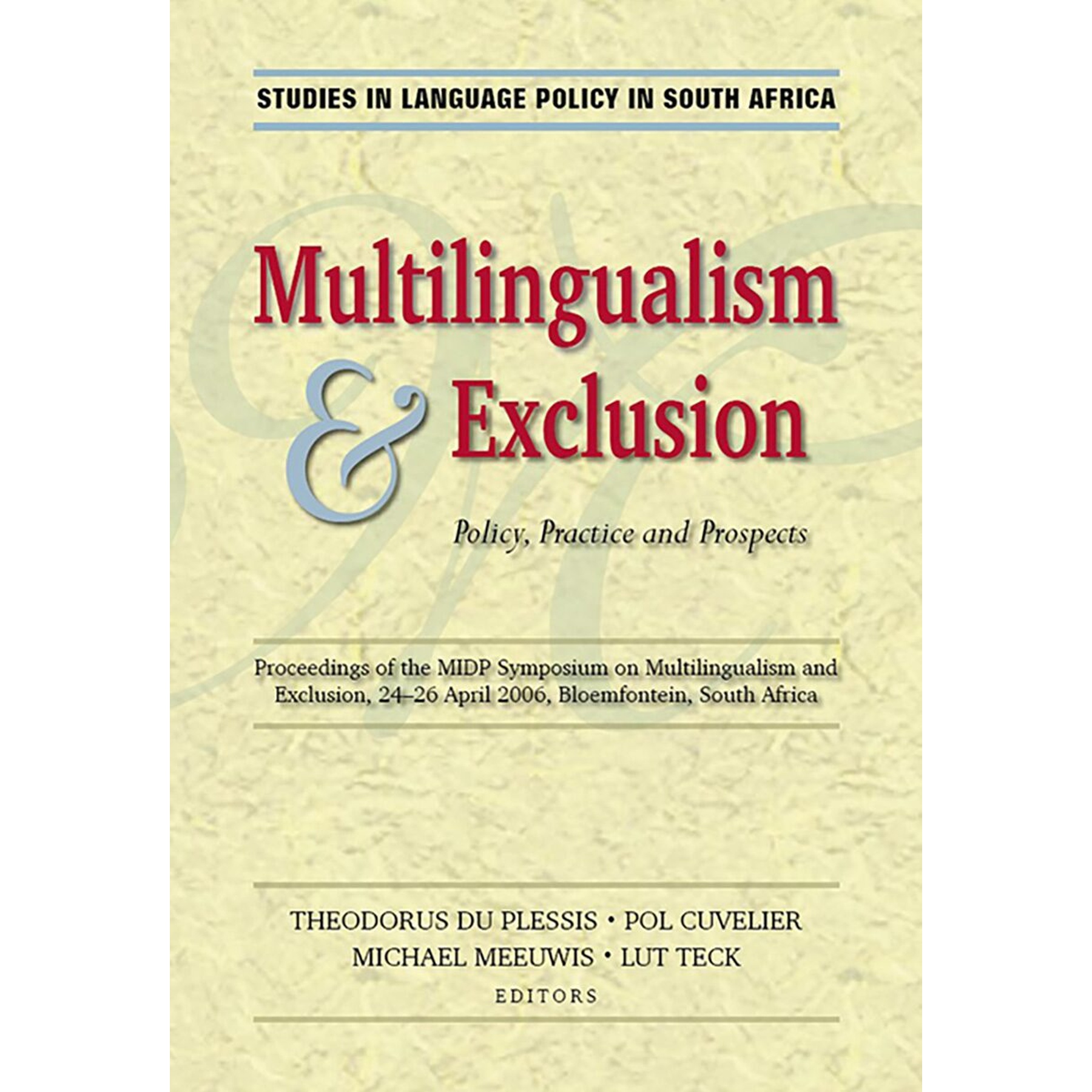
 Multilingualism and Exclusion – Practice and Prospects
Authors: T du Plessis, P Cuvelier, M Meeuwis, L Teck
Format: Physical Hardcopy
Whether the winds of globalisation, localisation and regionalisation of the last decades have led to more linguistic diversity or not, is a matter of on-going dispute - one reason being the changeable, language-ideological ways in which language practice is categorised and essentialised into countable linguistic units.
In contrast, it is less controversial that they have led to an increased visibility and awareness of linguistic diversity, as well as to a growing sensitivity and sensibility towards this diversity - in short, to a growing number (and a wider range) of meaning-ascribing discourses surrounding multilingualism.
The papers included in this book aim to draw attention to the fact that such discourses do not invariably reflect on, or give rise to, realities of societal integration and emancipation. In practice, they often follow, and are followed by, the mechanisms and effects of exclusion at different levels of society.
Multilingualism and Exclusion: Policy, Practice and Prospects resulted from the First International MIDP Symposium, "Multilingualism and Exclusion" - hosted jointly by the University of the Free State, the University of Antwerp and the University of Ghent - which was held in Bloemfontein from 24 to 26 April 2006.
The symposium comprised part of the MIDP colloquia series sponsored by the Province of Antwerp, and brought together several scholars from Africa, America and Europe, as well as from South Africa.
The selected papers included in this, the sixth volume in the Van Schaik series, "Studies in Language Policy in South Africa", critically reflect on themes such as multilingualism as a challenge for language planners and communities; multilingualism as an obvious, simple and superior option in all cases; the individual language user's experience; the management of multilingualism, etc.
The diversity of the contributions to this volume underscores the fact that exclusion in language, like any other type of exclusion, is based on difference. Not surprisingly, various "tools" have been mobilised to effectuate such exclusion, forced monolingualism being an obvious one.
Far more intriguing, however, is one of the findings made in this book - namely, that inclusion through multilingualism does not offer a simple and straightforward way to proceed. With Multilingualism and Exclusion: Policy, Practice and Prospects , the editors hope to evoke further discussion on the themes covered in this volume, as well as the opinions expressed by its contributors.
The book is particularly directed at readers interested in the intricate relations between language and society; but it can also be used effectively as an important reference work in courses in language policy and language planning with a South African or African focus.
 Contents:
-
Multilingualism and exclusion policy, practice and prospects Laughing it off: multi-national corporations, brand identity and the language of exclusion Language visibility and language exclusion: the case of the monolingual number plate of the Free State province Implications of the stocktaking study of mother-tongue and bilingual education in sub-Saharan Africa: who calls which shots? Eliminating dialect variation in Catalan local television: limitations and queries The monolingual testing of competence: acceptable practice or unfair exclusion Language exclusion: the role of ideological preconceptions, attitude to language and the lack of political will Multilingualism as injustice: African claims on colonial language policies in the Belgian Congo Dilemmas of language maintenance and shift amongst Indian South Africans Overcoming cultural exclusion – globalisation and localisation strategies in literary translation Multilingualism and exclusion: American Sign Language and South African Sign Language Hispanic heritage language speakers in the United States: linguistic exclusion in language education Linguistic plurality and the learning of the school language The challenge of language policy in a multilingual nation Exclusion and inclusion in Europe: the search for a European language policy Exclusion of minority groupings on the basis of language in South Africa, as reflected in the printed media The perception of exclusion and proximity through the use of standard Dutch, “tussentaal” and dialect in Flanders Language management towards diversity and unity at a recently emerged South African university The notion of exclusion in the language attitudes of young urbanites in Dakar English in higher education in South Africa: exclusion or inclusion?
For custom orders and quotes: shop@schoolspace.co.za
© 2026 Schoolspace. This product description is the exclusive intellectual property of the publisher, protected under copyright law. Unauthorized use, adaption, or copying is strictly prohibited.