

Product Description
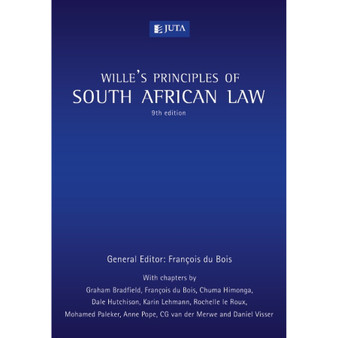
 Wille’s Principles of South African Law (9th edition) (eBook)
Format: Digital
The aim of this work is to set out the basic principles of South African private law systematically, in clear unmistakable language, and as comprehensively as is possible in a single volume.
The ninth edition has been extensively updated order to take account of major changes in the law in the 15 years since the previous edition. Many of these changes were necessitated or inspired by the Constitution, and were incorporated to improve and modernise the treatment of a topic. Where applicable the older, original authority for a proposition is cited alongside contemporary sources.
 Contents:
-
PART 1 - GENERAL
-
Law
-
Sources of law: Overview and Constitution
-
Sources of law: Legislation
-
Sources of law: Common law and precedent
-
Sources of law: Customary law and other sources
-
The legal system
-
PART II - PERSONS AND FAMILY
-
Introduction
-
Birth, name, domicile and death
-
Unborn persons
-
Females
-
Children (minors)
-
Extra-marital children
-
Marriage
-
Life partnerships
-
Mentally incapacitated persons
-
Insolvent persons
-
Convicted persons
-
Artificial persons
-
PART III - PROPERTY
-
The law of property, the concept of property and real rights
-
Possession
-
Ownership
-
Co-ownership, sectional ownership and other forms of title
-
Servitudes and other real rights
-
Real security
-
Succession
-
PART IV – OBLIGATIONS
-
A. Contracts
-
Contracts in General
-
Purchase and sale
-
Letting and hiring of property
-
Employment
-
Letting and hiring of work
-
Loan for consumption
-
Loan for use
-
Deposit
-
Carriage
-
Agency
-
Partnerships
-
Suretyship
-
Donation
-
B. Unjustified Enrichment
-
Unjustified enrichment
-
C. Delict by Daniel Visser
-
Compensation for pecuniary loss – the actio legis Aquiliae
-
The action for pain and suffering
-
Compensation for harm to the personality – the actioiniuriarum
-
Remedies based on strict liability
For custom orders and quotes: shop@schoolspace.co.za
© 2026 Schoolspace. This product description is the exclusive intellectual property of the publisher, protected under copyright law. Unauthorized use, adaption, or copying is strictly prohibited.