

Product Description
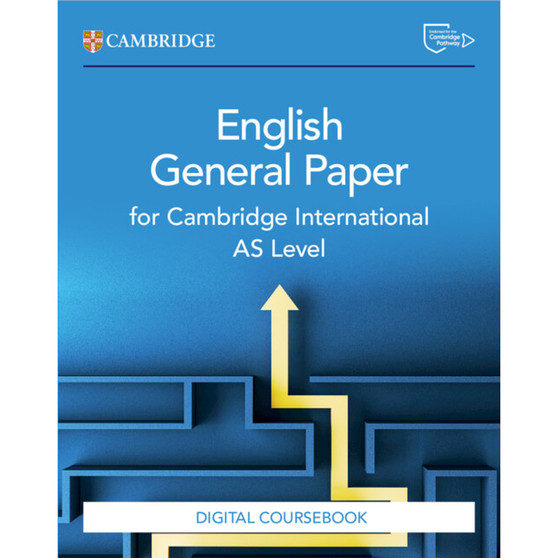
 Cambridge International AS Level English General Paper Digital Coursebook (2 Years)
Format: Digital
Students will explore a variety of topics, from technology to language and culture, to strengthen their skills of interpretation, critical thinking and analysis. This digital coursebook is structured in two parts – Part 1 Reading and Comprehension and Part 2 Academic Writing – to enable students to focus on improving their comprehension, use of English and essay writing skills in manageable sections.
Engaging activities and projects help students to develop their research skills and enhance their topical knowledge. Engaging video content builds upon the skills being taught in each chapter and aids understanding.
Suggested answers to the questions in the coursebook are accessible via Cambridge GO.
 Features:
-
‘Getting started’ feature is an active diagnostic tool for you to assess what students already know about a topic.
-
Scaffolded activities, including short written tasks, encourage active learning and provide formative assessment insights.
-
Questions prompt students to think about what evidence they need to add to their answer, helping to improve essay writing skills.
-
‘Discussion point’ feature prompts critical thinking at key points throughout the chapter.
-
Reading and writing checklists provide step-by-step guidance and planning support for various tasks, helping students break down the writing process.
-
‘Reflection’ feature encourages students to assess their work in pairs or groups, considering how they could adapt their approach for a different outcome.
-
Engaging, topical extracts and articles are explored and dissected to illustrate important skills and concepts, providing examples and aiding overall understanding.
-
Practice questions are included at the end of each chapter and at the end of each section, providing multiple opportunities to assess comprehension.
-
Sample answers help students understand the success criteria and provide an opportunity to evaluate and improve the answer.
-
Self-assessment opportunities at the end of each chapter encourage students to reflect on their learning and record a confidence rating.
-
This publication is still in development, so the accessibility information is currently unknown. We aim for our publications to meet WCAG 2.2 AA. An updated accessibility summary will be provided once available.
 Contents:
-
How to use this series
-
How to use this book
-
Introduction
-
Getting Started
-
Part 1 Reading and Comprehension Skills
-
1 Comprehension skills
-
1.1 Vocabulary
-
1.2 Identifying main ideas and supporting details
-
1.3 Reading strategies for comprehension
-
1.4 Summarising and paraphrasing
-
2 Exploring the text
-
2.1 Explicit and implicit meaning
-
2.2 Text structures
-
2.3 Identifying the writer's purpose
-
2.4 Use of language
-
2.5 Point of view and perspective
-
3 Analysing and evaluating ideas and evidence
-
3.1 Reading texts critically
-
3.2 Analysing meaning
-
3.3 Evaluating reasons and evidence
-
3.4 Making supported judgements
-
4 Writing persuasively
-
4.1 Expressing opinions and developing ideas
-
4.2 Structuring a persuasive response
-
4.3 Writing with style and purpose
-
4.4 Editing for clarity and impact
-
Reading comprehension practice questions
-
Part 2 Academic Writing Skills
-
5 Planning an essay
-
5.1 Essay basics
-
5.2 Understanding essay questions
-
5.3 Considering perspectives and evidence
-
5.4 Creating an essay plan
-
6 Writing an essay
-
6.1 Writing an effective introduction
-
6.2 Organising the main body of your essay
-
6.3 Writing an effective conclusion
-
7 Communicating effectively
-
7.1 Writing accurately
-
7.2 Choosing your vocabulary
-
7.3 Communicating formally
-
7.4 Checking your work
-
Essay-writing practice questions
-
Preparing for the assessment
-
Glossary
-
Acknowledgements
-
Index.
For custom orders and quotes: shop@schoolspace.co.za
© 2026 Schoolspace. This product description is the exclusive intellectual property of the publisher, protected under copyright law. Unauthorized use, adaption, or copying is strictly prohibited.