

Product Description
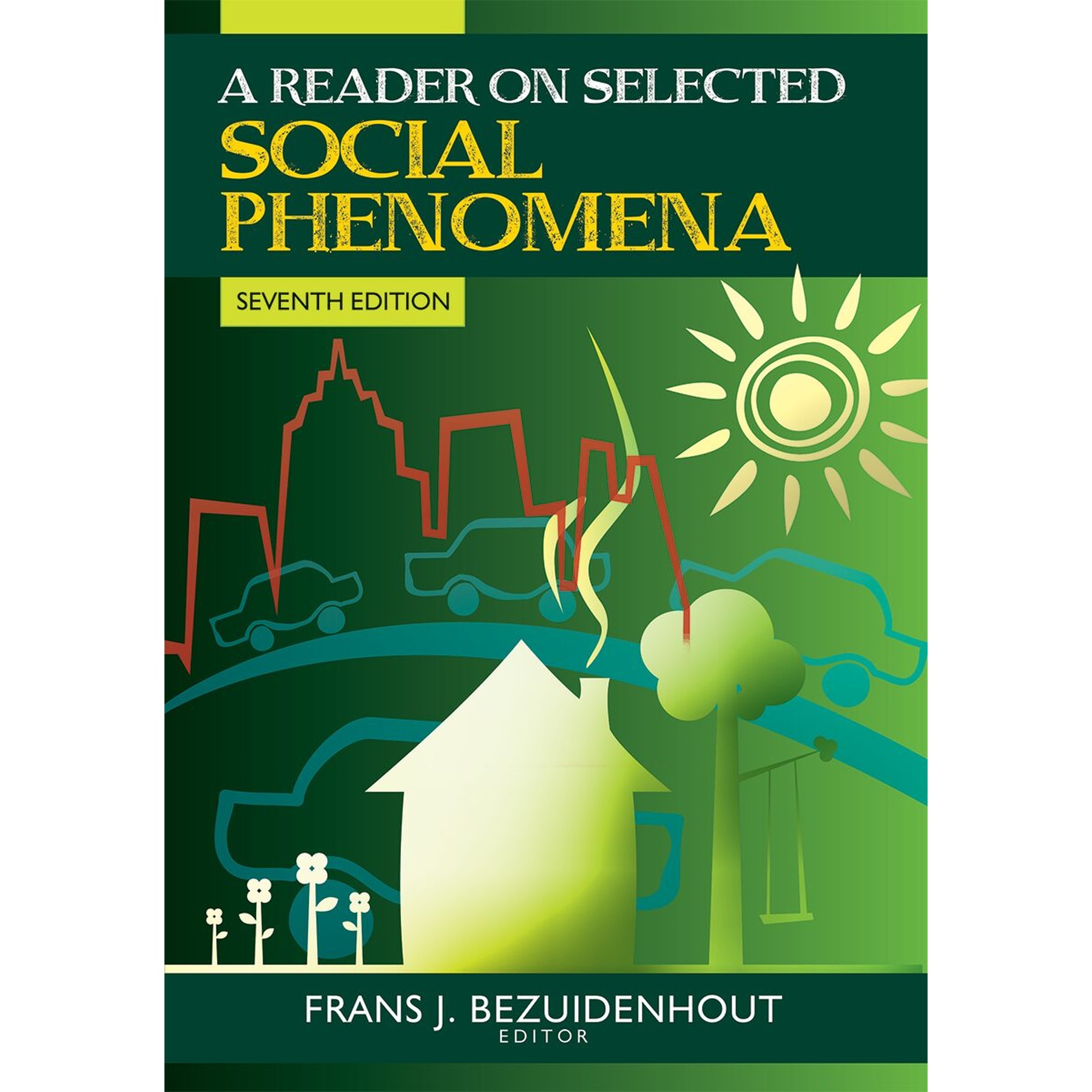
 A Reader on Selected Social Phenomena (7th edition)
Author: FJ Bezuidenhout
Format: Physical Hardcopy
While nations have long been involved in regulating humans’ relationships with other species, humans have to a much greater extent been involved in the problems of regulating and maintaining human society. Currently, the world has a population of 7.8 billion and it is estimated that by 2050, this will be 9.8 billion. Along with this burgeoning population pressure comes a host of challenges. A Reader on Selected Social Phenomena discusses the nature, prevalence, causes and consequences of 17 social phenomena.
The content of the chapters is not discipline specific. Lecturers can therefore use perspectives within their own field of study or interest to guide their students to greater understanding. Content-wise, each phenomenon, as presented in a chapter, has been placed in a specific section to highlight and contextualise its nature and effect on the individual, family, community and society. These sections are as follows:
"Discussion topics are well thought out. My experience is that they enhance student participation. The text is of adequate length, addresses most of the curriculum outcomes, and is written in simple language." — Lecturer – S.G. Lourens Nursing College, Pretoria
"Social workers deal with social phenomena and issues. The overview provided is concrete, yet expansive in breadth. It provides an excellent point of departure." - Lecturer –Department of Social Work, University of Johannesburg, Johannesburg
"It is a very applicable text for nursing science students – giving them insight into and making them aware of social phenomena – in their communities; even in their own homes." — Lecturer – Free State School of Nursing, Bloemfontein
"Outcomes-based – the content encourages students to actively participate in class and to broaden their involvement in aspects such as prevention and support." — Lecturer – Chris Hani Baragwanath Nursing College, Soweto
"This reader intelligently demonstrates the intersection between psychosocial, educational, economic and political issues. These contradictions reflect in schools, which are a microcosm of society. Student teachers are therefore confronted with these phenomena daily and should be aware of these contradictions and how to deal with them." - Dr Muki Moeng, Executive Dean: Education and Education Management – Nelson Mandela University, Gqeberha
 Features:
-
Marriage and family • Childhood and adolescence • Health issues • Destructive behaviours • Human rights and justice • Population and environmental issues
 Contents:
-
SECTION 1 MARRIAGE AND FAMILY CHAPTER 1 Family disorganisation and violence CHAPTER 2 Divorce, separation and cohabitation
-
SECTION 2 CHILDHOOD AND ADOLESCENCE
-
CHAPTER 3 Child maltreatment
-
CHAPTER 4 Teen and adolescent pregnancy
-
CHAPTER 5 Adolescence and youth risk taking
-
CHAPTER 6 Juvenile offending
-
SECTION 3 HEALTH ISSUES
-
CHAPTER 7 Feeding, nutritional and eating disorders in children, adolescents and youth
-
CHAPTER 8 Substance- and non-substance-related use, misuse and abuse
-
CHAPTER 9 HIV and AIDS as cross-cutting social phenomena
-
SECTION 4 DESTRUCTIVE BEHAVIOURS
-
CHAPTER 10 Self-harming behaviours
-
CHAPTER 11 Death by suicide
-
CHAPTER 12 Crime and criminal behaviour
-
SECTION 5 HUMAN RIGHTS AND JUSTICE CHAPTER 13 Sexual violence and human rights CHAPTER 14 Trafficking in persons
-
SECTION 6 POPULATION AND ENVIRONMENTAL ISSUES
-
CHAPTER 15 Population issues
-
CHAPTER 16 Poverty and unemployment
-
CHAPTER 17 Environmental issues
For custom orders and quotes: shop@schoolspace.co.za
© 2026 Schoolspace. This product description is the exclusive intellectual property of the publisher, protected under copyright law. Unauthorized use, adaption, or copying is strictly prohibited.