

Product Description
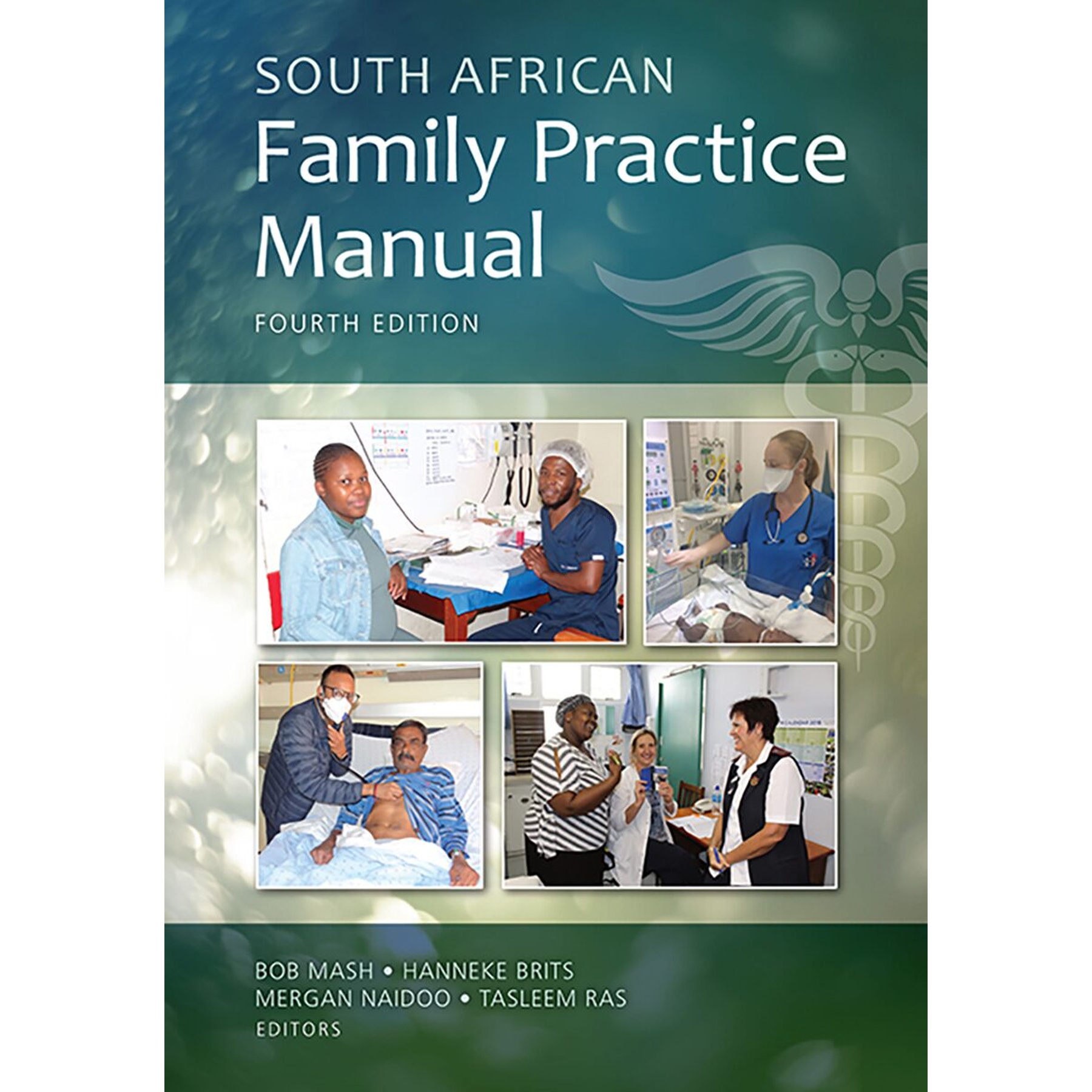
 South African Family Practice Manual (4th edition)
Authors: B Mash, H Brits, M Naidoo, T Ras
Format: Physical Hardcopy
South African Family Practice Manual is a practical text that focuses on the “how to” of working in the district health services. It includes the core skills required of family physicians, which registrars in family medicine need to acquire during their training, as well as additional skills relevant to family practice in different settings.
It is also relevant to other clinicians working in district health services, such as medical officers, general practitioners, nurse practitioners and clinical associates, in both primary health care and district hospital environments.
The majority of skills are clinical and cover health promotion, disease prevention, therapeutics and interventions, rehabilitation and palliative care for both adults and children. There are also sections that deal with skills related to supporting community-oriented primary care, clinical training and teaching as well as leadership and clinical governance.
South African Family Practice Manual is a project of the South African Academy of Family Physicians, which is the national professional body for family medicine, and has been a key resource for family medicine training in this country as well as many others across Africa. This fourth edition has three new section editors and a wide variety of new authors to ensure that the content is relevant to the next generation of family physicians.
New topics have been added, such as history taking in sexual health, point-of-care ultrasound, helping people with impairments, and mentoring and helping the learner in difficulty. All chapters have been revised to ensure that they are up to date. South African Family Practice Manual is relevant for medical students, interns, medical officers, registrars, general practitioners and family physicians, as well as nurse practitioners and clinical associates, all of whom will find many of the skills essential to their development and practice.
 Contents:
-
SECTION 1: THE CONSULTATION 1. How to communicate effectively in the consultation 2. How to consult a child or adolescent 3. How to take a sexual history 4. How to perform a brief, appropriate neurological examination 5. How to examine the feet of patients with diabetes 6. How to do a rapid musculo-skeletal screening examination 7. How to examine and assess low back pain 8. How to do brief behaviour change counselling 9. How to break bad news 10. How to develop a counselling style 11. How to work with an interpreter 12. How to manage the difficult patient 13. How to assess family structure and resources 14. How to assess family function 15. How to hold a family conference
-
SECTION 2: COMMUNITY-ORIENTATED PRIMARY CARE 16. How to support the implementation of community-orientated primary care 17. How to provide support to primary health care teams in your community 18. How to link the primary health care teams to the rest of the health system, other sectors and the community
-
SECTION 3: CHILD HEALTH 19. How to do a developmental assessment 20. How to assess growth and classify malnutrition in children 21. How to do childhood immunisation 22. How to administer an intramuscular injection to a child 23. How to do a suprapubic bladder aspiration in a a young child 24. How to get intravenous access in a child 25. How to establish an intraosseous infusion in a child 26. How to perform a lumbar puncture in a child 27. How to assess a child’s chest radiograph 28. How to do a skin test for tuberculosis in a child 29. How to assess and manage child abuse 30. How to use the Road to Health booklet 31. How to do a well newborn check 32. How to assess gestational age at birth 33. How to resuscitate a newborn 34. How to insert an umbilical vein catheter 35. How to establish kangaroo mother care for preterm infants 36. How to manage phototherapy 37. How to use the Integrated Management of Childhood Illness chart booklet
-
SECTION 4: WOMEN’S HEALTH 38. How to use the antenatal growth chart 39. How to examine a pregnant woman 40. How to do a single screening ultrasound in pregnancy 41. How to assess foetal wellbeing through its movements 42. How to assess foetal wellbeing during labour 43. How to use a partogram and assess progress of labour 44. How to conduct a normal vaginal delivery 45. How to conduct an assisted vaginal delivery 46. How to do a Caesarean section 47. How to do and suture an episiotomy 48. How to repair a third-degree tear 49. How to remove the placenta manually 50. How to do cervical cancer screening 51. How to insert long-term contraceptive devices:intrauterine contraceptive devices and hormonal implants 52. How to do a minilaparotomy tubal ligation 53. How to do a laparoscopic tubal ligation 54. How to do a medical termination of pregnancy 55. How to do a manual vacuum aspiration 56. How to do a laparotomy for ectopic pregnancy 57. How to do culdocentesis 58. How to treat a Bartholin’s cyst or abscess 59. How to do an endometrial biopsy 60. How to do a paracervical block and remove a cervical polyp 61. How to take care of a sexually assaulted person 62. How to use and implement ESMOE
-
SECTION 5: ADULT HEALTH 63. How to perform a lumbar puncture in an adult 64. How to record an electrocardiogram 65. How to interpret an electrocardiogram 66. How to do an exercise electrocardiogram test 67. How to use inhalers and spacers 68. How to do office spirometry 69. How to use a peak expiratory flow meter 70. How to read a chest radiograph 71. How to do a pleural tap 72. How to nebulise a patient 73. How to take blood samples in adults 74. How to give an injection 75. How to interpret a barium swallow
-
SECTION 6: MENTAL HEALTH 76. How to manage a mental health care user in terms of the Mental Health Care Act 77. How to do a mini mental-state examination 78. How to screen for mental problems 79. How to screen for an alcohol drinking problem
-
SECTION 7: ENT, EYES AND SKIN 80. How to examine the eye 81. How to treat the eye 82. How to remove a foreign body from the nose 83. How to remove a foreign body from the ear canal 84. How to examine and treat the ear 85. How to examine the mouth and throat, and collect oral and nasal specimens 86. How to do a tonsillectomy 87. How to drain a peritonsillar abscess 88. How to manage epistaxis 89. How to evaluate nasal trauma 90. How to conduct skin prick testing 91. How to do a skin biopsy, cryotherapy and electrotherapy 92. How to excise a sebaceous cyst 93. How to apply a compression bandage for chronic venous ulcers 94. How to partially remove a nail to manage an ingrowing toenail 95. How to treat warts 96. How to approach the care of acute and chronic wounds
-
SECTION 8: ORTHOPAEDICS 97. How to examine for and inject a painful shoulder 98. How to examine for and inject tennis elbow and golfer’s elbow 99. How to examine for and inject De Quervain’s tenosynovitis 100. How to examine for and inject carpal tunnel syndrome 101. How to measure shortening of the legs 102. How to diagnose and inject trochanteric bursitis 103. How to examine, aspirate and inject an inflamed knee 104. How to assess acute ankle injury 105. How to interpret radiographs of arthritic joints 106. How to apply plaster casts and splints 107. How to apply traction 108. How to do closed reduction of common limb fractures 109. How to reduce dislocations of the shoulder, elbow and hip 110. How to aspirate or excise ganglia 111. How to apply a clubfoot cast 112. How to perform an emergency fasciotomy
-
SECTION 9: SURGERY 113. How to do a vasectomy 114. How to do a circumcision 115. How to manage haemorrhoids and perianal haematomas 116. How to read an abdominal radiograph 117. How to do fine-needle aspiration biopsy, a core needle biopsy and excision biopsy 118. How to insert a urinary catheter 119. How to do proctoscopy and sigmoidoscopy 120. How to reduce a paraphimosis 121. How to perform a ring block of the penis 122. How to incise and drain an abscess 123. How to drain or remove a hydrocoele 124. How to interpret an intravenous pyelogram 125. How to perform a lower extremity amputation 126. How to perform an appendectomy
-
SECTION 10: ANAESTHETICS 127. How to do a pre-anaesthetic assessment 128. How to administer oxygen 129. How to check the anaesthetic machine 130. How to administer general anaesthesia 131. How to provide inhalational induction of anaesthesia 132. How to monitor a patient during anaesthesia 133. How to monitor a patient recovering from anaesthesia 134. How to administer and reverse muscle relaxants 135. How to administer regional anaesthesia and local blocks 136. How to administer a spinal anaesthetic 137. How to administer procedural sedation and analgesia 138. How to perform ketamine anaesthesia 139. How to decontaminate anaesthetic equipment
-
SECTION 11: EMERGENCIES 140. Algorithms for emergencies 141. How to intubate a patient and manage the airway 142. How to do a cricothyroidotomy 143. How to insert an intercostal drain 144. How to relieve a tension pneumothorax 145. How to insert a central venous line 146. How to relieve a cardiac tamponade 147. Transcutaneous cardiac pacing 148. How to do a primary survey 149. How to do a secondary survey 150. How to obtain an arterial blood sample 151. How to do a point of care ultrasound 152. How to insert a nasogastric tube 153. How to give a blood transfusion 154. How to measure the Glasgow Coma Scale 155. How to interpret X-rays in a trauma patient 156. How to calculate the percentage of burn 157. How to manage poisoning or toxic exposure 158. How to restrict spinal motion 159. How to transport a critically ill patient from primary to secondary care 160. How to remove percutaneous foreign bodies 161. How to suture a laceration 162. How to debride a wound
-
SECTION 12: REHABILITATION 163. Approach to assessing disability and rehabilitation 164. How to assess a patient requesting a disability grant 165. The role of the family physician in the rehabilitation of a stroke patient 166. A structured approach to coordinating the care of people and families with cerebral palsy 167. How to care for a person with spinal cord affliction 168. How to care for amputees
-
SECTION 13: PALLIATIVE CARE 169. How to care for the dying patient and communicate with the patient and family 170. The use of syringe drivers to deliver continuous subcutaneous infusions in palliative care 171. How to assess pain
-
SECTION 14: CLINICAL MANAGEMENT AND ADMINISTRATION 172. How to keep a patient’s medical records 173. How to notify a death 174. How to fill in a certificate of illness 175. How to notify a medical condition 176. How to refer and discharge a patient 177. How to assess fitness for driving at work 178. How to claim compensation for work-related injuries or diseases 179. How to complete a J88 form for an assault case and prepare for an appearance in court 180. How to assess drunk driving and the responsibilities of the doctor
-
SECTION 15: CLINICAL TRAINING AND TEACHING 181. How to establish an effective learning environment 182. How to to use a portfolio of learning 183. How to plan and implement a teaching activity 184. How to have effective learning encounters in the workplace 185. How to facilitate small-group learning 186. How to prepare a presentation 187. How to mentor a colleague 188. How to recognise and help the learner in difficulty
-
SECTION 16: LEADERSHIP AND CLINICAL GOVERNANCE 189. How to audit and improve the quality of your service 190. How to take on leadership roles and initiate teamwork 191. How to organise and run morbidity and mortality meetings 192. How to deal with a medical mistake 193. How to manage the impaired health practitioner or colleague 194. How to enable resilience and avoid burnout
For custom orders and quotes: shop@schoolspace.co.za
© 2026 Schoolspace. This product description is the exclusive intellectual property of the publisher, protected under copyright law. Unauthorized use, adaption, or copying is strictly prohibited.