

Product Description
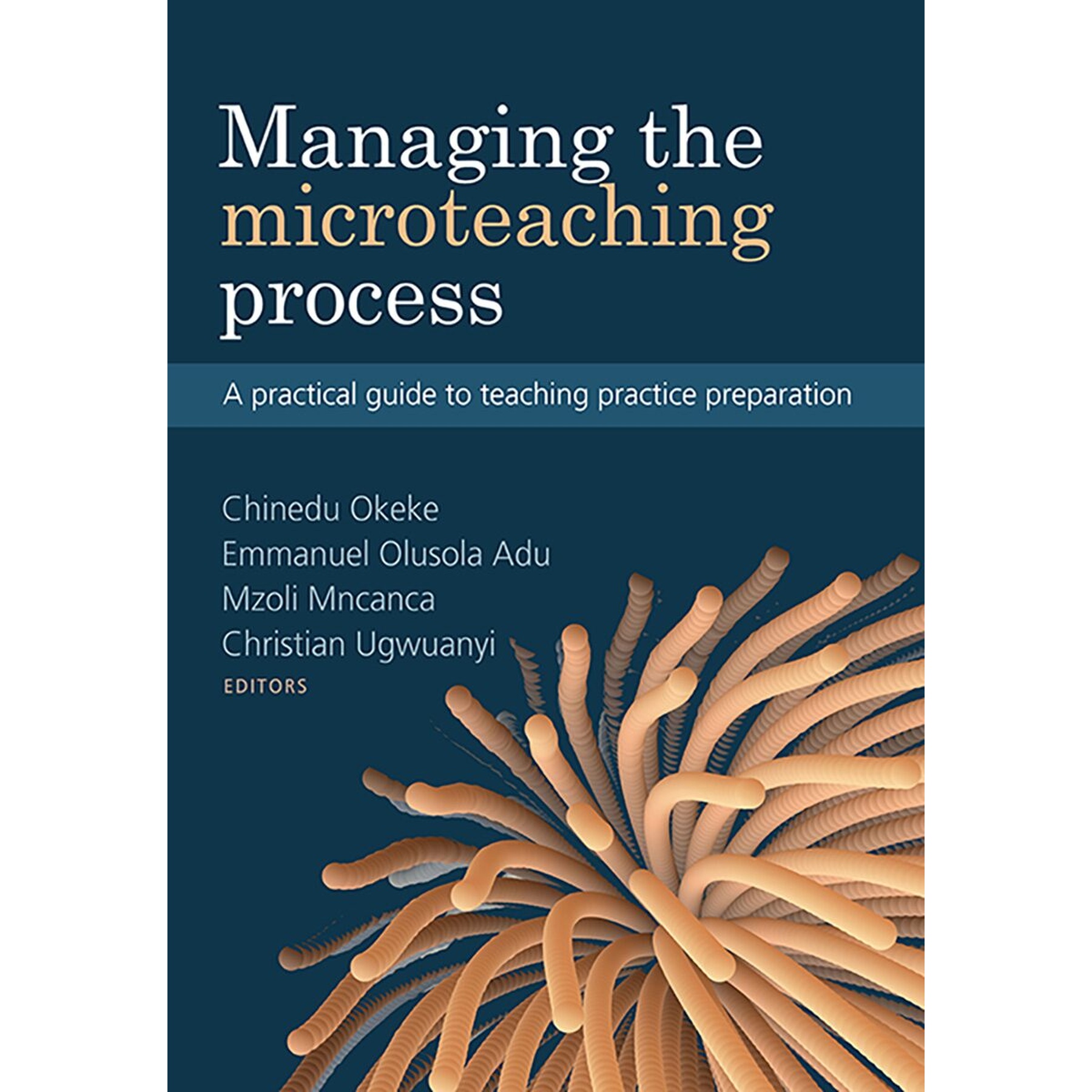
 Managing the Microteaching Process
Authors: C Okeke, E Olusola Adu, M Mncanca, C Ugwuanyi
Format: Physical Hardcopy
In South Africa and elsewhere in the world, those in the teaching profession require specialised knowledge and skills if they are to prepare learners to develop to their fullest potential and grow up to be the best that they can be.. However, many of these competencies can only be imparted through the actual practice of teaching.
Managing the Microteaching Process: a practical guide to teaching practice preparation is a resource developed to support the teaching practice module of pre-service teaching programmes offered at tertiary institutions in South Africa and other African countries.
Managing the Microteaching Process: a practical guide to teaching practice preparation provides lecturers and students in both face-to-face and open distance learning environments with the opportunity to participate in simple, carefully planned teacher training tasks. In addition to covering the theoretical foundation, it develops teaching knowledge and skills through practising in a controlled environment.
Contents include the following:
 Features:
-
Entry behavioural skills
-
Lesson induction
-
Skills of explanation
-
Planning and presenting a lesson
-
Receiving feedback
-
Teacher and learner activities
-
Skills of assessment
-
e-Portfolios
 Contents:
-
PART ONE: ADMINISTERING MICROTEACHING Chapter 1: Discussion of the administration of the microteaching process and content
-
PART TWO: THE PROCESS SESSION – LECTURER ROLE
-
Chapter 2: Introduction to microteaching
-
Chapter 3: Entry behavioural skills for learners in teaching and learning
-
Chapter 4: Lesson induction: the skill of introducing a lesson
-
Chapter 5: Skills of explanation in teaching and learning
-
Chapter 6: Stimulus variation skills
-
Chapter 7: Probing question skills
-
Chapter 8: Skills of reinforcement
-
Chapter 9: Skills of chalkboard/whiteboard writing
-
Chapter 10: Microsoft PowerPoint presentation skills
-
Chapter 11: Skills of illustration
-
Chapter 12: Management of teaching–learning resources
-
Chapter 13: Skills of feedback and feedback management
-
PART THREE: THE PRACTICE SESSION
-
Chapter 14: Selection of microteaching topics by pre-service teachers
-
Chapter 15: Selecting the microteaching skills to demonstrate
-
Chapter 16: Writing instructional objectives
-
Chapter 17: Planning a lesson
-
Chapter 18: Teaching and learning phase: Presenting a lesson
-
Chapter 19: Teacher and learner activities in a microteaching class
-
Chapter 20: Skills of assessment in microteaching
-
Chapter 21: Receiving feedback in a microteaching class
-
Chapter 22: Re-planning, re-teaching and re-feedback in microteaching
-
PART FOUR: MICROTEACHING IN AN ODL CONTEXT
-
Chapter 23: Contextualising microteaching: How microteaching differs in ODL context
-
Chapter 24: Simulation of teaching in an ODL microteaching classroom
-
Chapter 25: ICT integrated microteaching in an ODL context
-
Chapter 26: A social media-based model of microteaching for ODL
-
Chapter 27: The use of e-portfolios in an ODL context
For custom orders and quotes: shop@schoolspace.co.za
© 2026 Schoolspace. This product description is the exclusive intellectual property of the publisher, protected under copyright law. Unauthorized use, adaption, or copying is strictly prohibited.