

Product Description
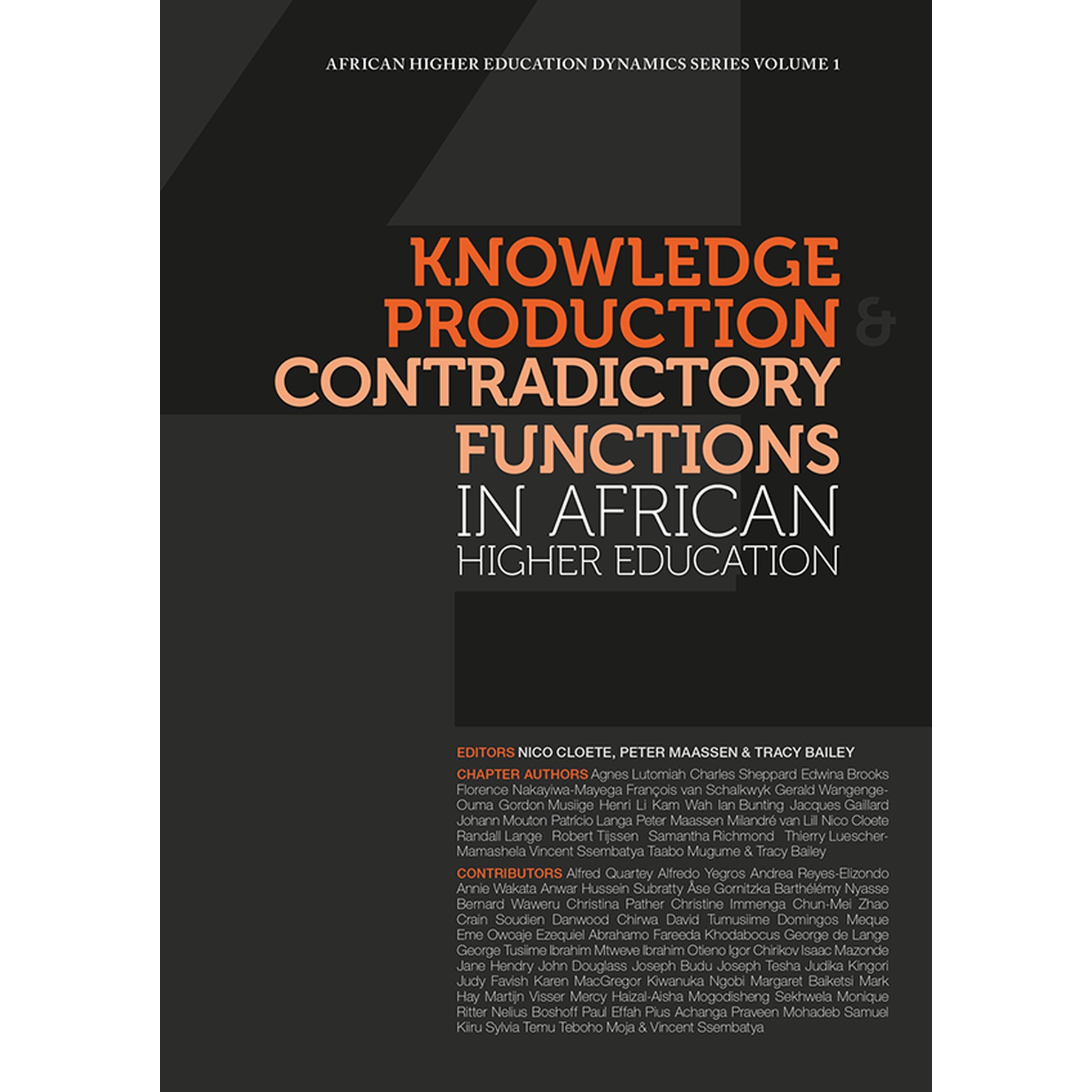
 Knowledge Production and Contradictory Functions in African Higher Education
Authors: Nico Cloete, Peter Maassen
Format: Paperback
Currently, Africa has more than half of the 20 fastest-growing economies in the world, which has contributed to what has been called the era of ‘Africa Rising’ or a ‘New Africa’. In order to further strengthen socio-economic development, African universities need to improve their ability to produce and apply knowledge in effective and relevant ways. In OECD countries there are several public and private sites for knowledge production, but in Africa the university is the only knowledge institution, and hardly any knowledge is produced outside of the university.
However, the performance of African universities in knowledge production has not been impressive. It has generally been acknowledged by agencies such as the African Observatory for Science, Technology and Innovation and the World Bank, as well as leading development scholars, that African universities are lagging behind the rest of the world in their knowledge production function. There has been only weak empirical evidence on the actual performance of universities, with virtually no cross-institutional and cross-country comparative research on the factors that are responsible for the poor performance of universities in knowledge production across the continent.
The crossroads African universities are facing consist of, on the one hand, a familiar path of relative decoupling between the university and its nation’s socio-economic development and, on the other hand, a path that requires far-reaching changes that could make it possible for the African university to connect much more productively to the main actors in emerging national (and in some cases regional) development and innovation networks. For the latter path to become accessible, these universities and their national authorities need research-rooted information.
“Overall this is an excellent publication, one that most people will want to read. It shows why the knowledge production functions were not developed historically in sub-Saharan Africa, and lays out what needs to be done to get them moving, with data based on evidence. It presents especially rich and very relevant material which I have found extremely useful, as will others. As someone who has done a great deal of quantitative analysis, including survey research, and has worked on the international collection of university data, I know how very difficult it is to collect accurate and useful data of this kind. The HERANA group and CHET are to be congratulated on the care and time they took in preparing this study, gathering and checking the data, and presenting it in this book. The study breaks new ground, is a major contribution to our understanding of higher education in sub-Saharan Africa and will significantly reward the reader’s attention.” — Fred Hayward, South African Journal of Science
“[Its] commitment to painstaking data gathering (working to improve university data collection systems as the project proceeded) […] marks out both this collection and the eight years of work by the Higher Education Research and Advocacy Network in Africa (HERANA) that underpin it. […] The book’s examination of the different ways in which universities can and do play a developmental role is its particular strength.” — Jonathan Harle, INASP, Oxford
“We need more research in universities, more PhDs and, very important, research on higher education for change – actually I am promoting the improvement of data for the whole of Africa because policy making in Africa must become more data driven.” — Kofi Annan during his address at the book launch during the African Higher Education Summit, held 10-12 March in Dakar, Senegal
“The dominant global discourse in higher education now focuses on ‘world-class’ universities – inevitably located predominantly in North America, Europe and, increasingly, East Asia. The rest of the world, including Africa, is left to play ‘catch-up’. But that discourse should focus rather on the tensions, even contradictions, between ‘excellence’ and ‘engagement’ with which all universities must grapple. Here the African experience has much to offer the high-participation and generously resourced systems of the so-called ‘developed’ world. This book offers a critical review of that experience, and so makes a major contribution to our understanding of higher education.” — Sir Peter Scott, former editor of Times Higher Education and Professorof Higher Education Studies, University College London, Institute of Education
“This volume brings together excellent scholarship and innovative policy discussion to demonstrate the essential role of higher education in the development of Africa and of the world at large. Based on deep knowledge of the university system in several African countries, this book will reshape the debate on development in the global information economy for years to come. It should be mandatory reading for academics, policy-makers and concerned citizens, in Africa and elsewhere.” — Manuel Castells, Professor Emeritus, University of California at Berkeley, Laureate of the Holberg Prize 2012 and of the Balzan Prize 2013
For custom orders and quotes: shop@schoolspace.co.za
© 2026 Schoolspace. This product description is the exclusive intellectual property of the publisher, protected under copyright law. Unauthorized use, adaption, or copying is strictly prohibited.