

Product Description
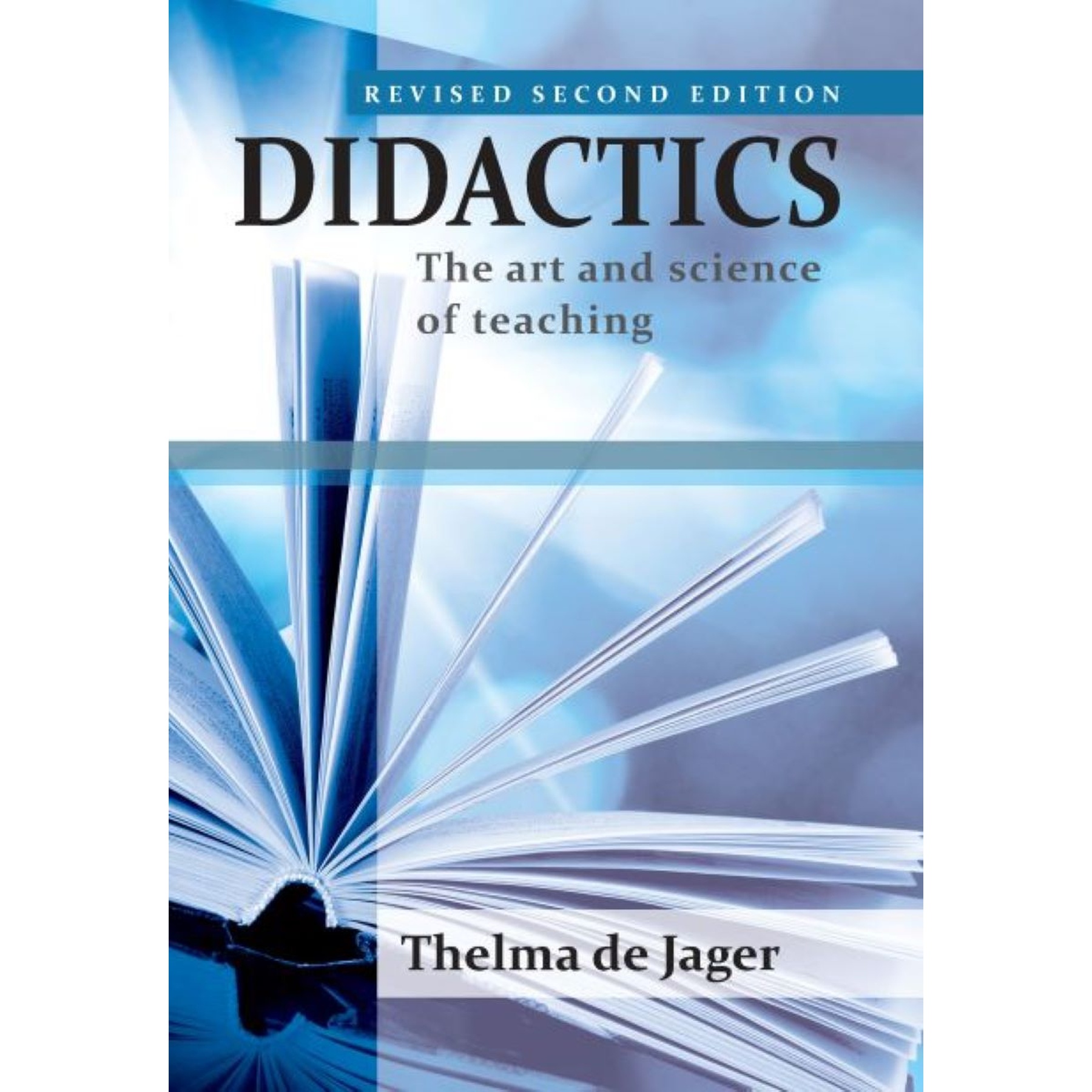
 Didactics – The Art and Science of Teaching (revised 2nd edition)
Author: T de Jager
Format: Physical Hardcopy
Every young South African needs quality schooling, and well-trained, capable and confident teachers are very important in imparting knowledge, values and skills to their learners. Teachers therefore need to execute fundamental and challenging tasks in and outside the classroom, meet the diverse needs of South African learners in the 21st century and continually enhance their professional development, performance and competence in the workplace.
In Didactics: the art and science of teaching , practical guidance is provided for both the experienced and student teacher on how to teach effectively in the challenging South African education system, ultimately to contribute to diverse and quality education.
Contents include the following:
Didactics: the art and science of teaching is aimed at all prospective and practising teachers who need to acquaint themselves with the basic competency requirements for effective and quality teaching in any South African classroom.
Prof. Thelma de Jager is the Assistant Dean: Research, Innovation and Engagement at the Tshwane University of Technology. She taught Didactics (how to teach) and trained student teachers on how to teach effectively. She has presented and published papers nationally and internationally in accredited and peer-reviewed journals and conferences.
She has received “Lecturer of the Year” (Faculty: Humanities) and “Woman Researcher of the Year” awards several times and was also selected to participate in the National Teaching and Learning Awards of higher education.
She has been involved in teaching learners with special educational needs (LSEN), as well as primary and secondary school teaching, for more than two decades. She obtained her doctoral degree from the University of South Africa.
 Features:
-
Concepts of General Subject Didactics versus Specific Subject Didactics
-
Roles and characteristics of competent teachers
-
Theoretical models of learning
-
Development of curricula (application of both indigenous knowledge and Western science)
-
Teaching methods and strategies
-
Learning barriers and learner support (differentiated activities)
-
Methods, techniques and tools of assessment
-
Media and technology in the classroom
-
The advantages of teaching coding using offline (unplugged) activities and games
-
Hints and tips for teaching coding and robotics using offline activities and games
 Contents:
-
Chapter 1 Introduction to Didactics
-
Chapter 2 The teacher
-
Chapter 3 Curriculum
-
Chapter 4 Teaching methods and strategies
-
Chapter 5 Inclusive education
-
Chapter 6 Assessment
-
Chapter 7 Communication, media and technology
For custom orders and quotes: shop@schoolspace.co.za
© 2026 Schoolspace. This product description is the exclusive intellectual property of the publisher, protected under copyright law. Unauthorized use, adaption, or copying is strictly prohibited.